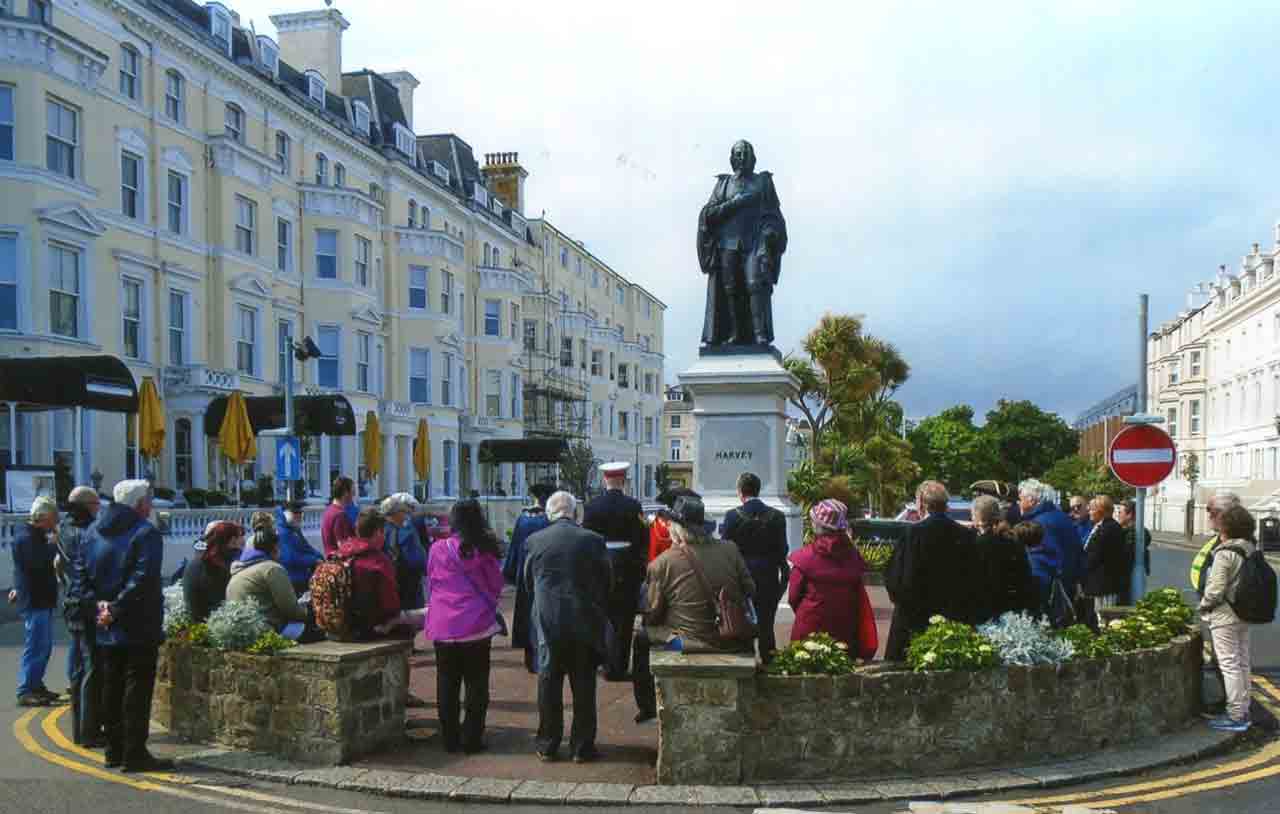
The commemoration at the Harvey statue Words and Photos By Ray Duff
Civic dignitaries, local residents, and historians gathered in Folkestone on Sunday to pay tribute to the life, legacy, and groundbreaking discoveries of the town’s most famous son, Dr William Harvey.
The annual commemoration began at The Burlington Hotel, where the Mayor of Folkestone, Councillor Jackie Meade, and Deputy Mayor, Councillor Nicola Keen, joined members of the Harveian Society of London for a formal lunch. Following the reception, the mayoral party paraded along The Leas, passing the historic bandstand, before arriving at the 1881 Harvey statue situated at the top of Langhorne Gardens.
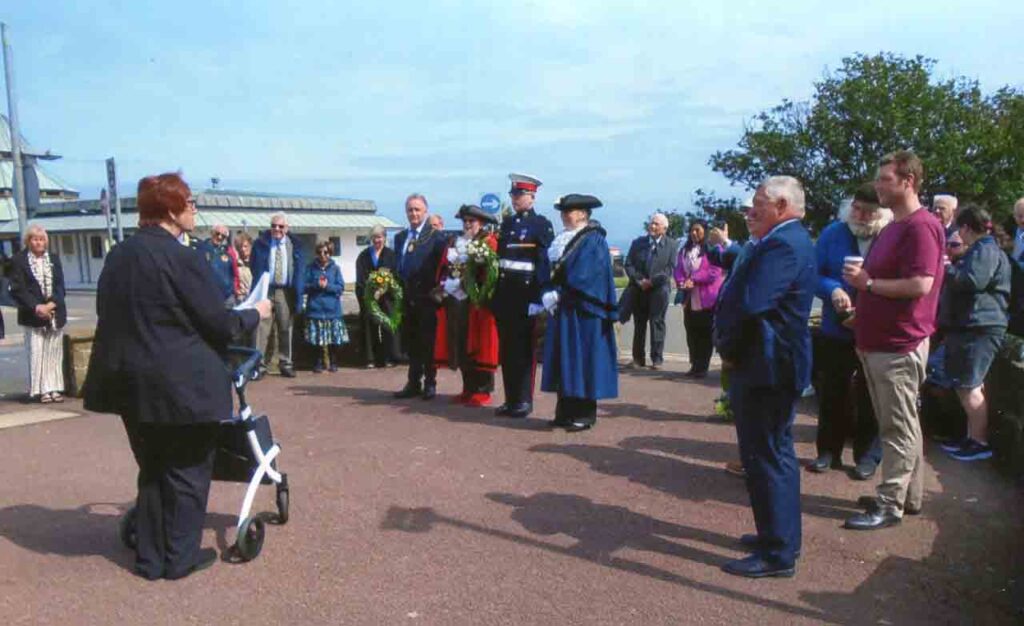
Rev Kate McNeice welcomes all to the event Photo: Ray Duff
A crowd of local residents and historians assembled at the statue, where the Mayor’s chaplain, Kate McNeice, opened the proceedings with a welcome address and prayers. This was followed by a poignant wreath-laying ceremony. Three chaplet wreaths were laid at the base of the monument: the first by the Mayor on behalf of the town and district, the second by Dr David Munnery representing the Harveian Society, and the third by Mr Terry Begent on behalf of local historians.
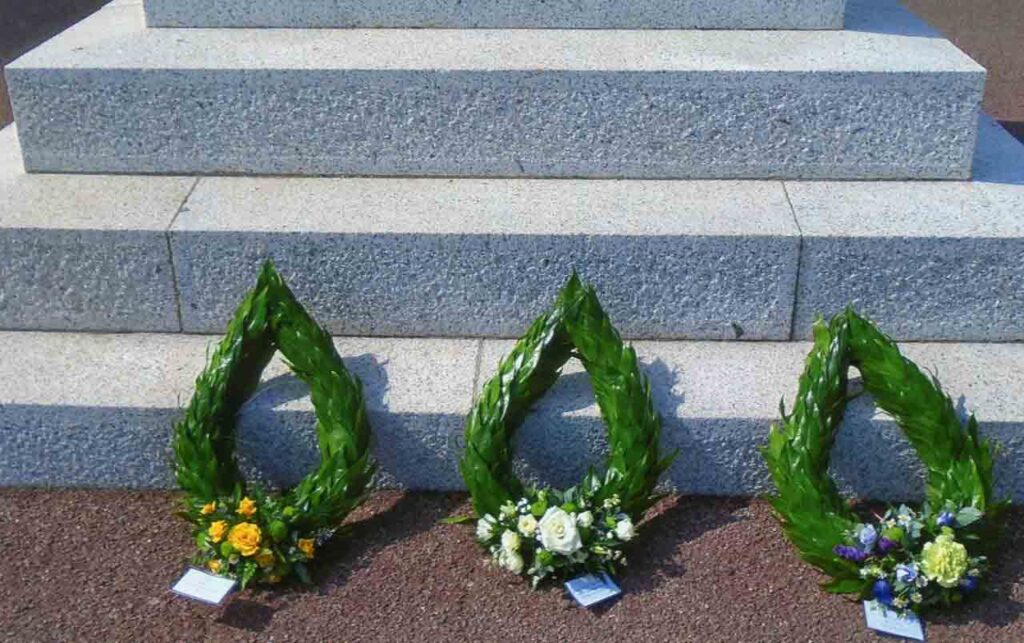
The memorial caplet wreaths laid at the base of the statue Photo: Ray Duff
Addressing the gathering, Dr Munnery reflected on the enduring and vital importance of Harvey’s 17th-century medical discoveries. He highlighted the profound impact of Harvey’s seminal work, De Motu Cordis, published in 1628, which fundamentally changed the understanding of the human circulatory system and remains a cornerstone of modern medicine.
Following the ceremony at the statue, the procession moved further along The Leas, walking through the Parish Churchyard to Church Street. The crowd paused briefly beneath the memorial plaque that marks the closest known location to Harvey’s birthplace in 1578.
The day’s events concluded at Folkestone Town Hall, featuring a captivating guest speech by retired judge and barrister Sir John Munnery, father of Dr David Munnery. Sir John shared a light-hearted recollection of growing up around Dover and attending Dover Grammar School, noting that he first became aware of Folkestone’s famous physician through a completely different William Harvey—a local farmer from Nonington.
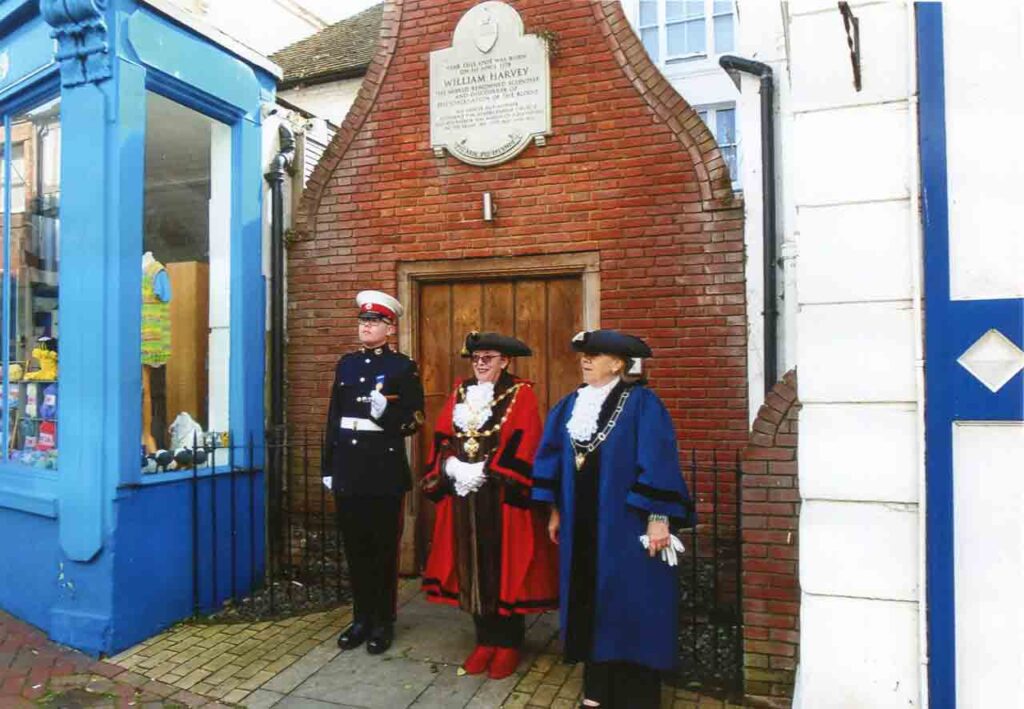
The Mayor and Deputy Mayor by the memorial birthplace plaque Photo: Ray Duff
Shifting focus to the physician’s academic career, Sir John spoke about Dr Harvey’s exceptional talent as a lecturer at the College of Physicians in London between 1616 and 1654. He described how Harvey enthralled his students despite facing immense scepticism from contemporaries. Sir John noted that it took several decades for Harvey’s revolutionary ideas to achieve universal acceptance. The speech was met with warm and enthusiastic applause from the assembled guests, bringing the day’s commemorations to a fitting close.
THE MAJOR ANNIVERSARIES IN 2028
Folkestone Town Council recently received a grant to put on a major exhibition about the work of Dr William Harvey from the prestigious Royal Society and their ‘Places of Science’ fund.
This because 2028 marks two big Harvey anniversaries, these being the 450th of his birth on 01 April 1578, and the 400th anniversary of the publication of his seminal work ‘De Cordu Mortis in 1628.
It is likely there will be other events both in Folkestone, London and indeed around the world for these anniversaries.
Further info:
Dr Harvey: – https://www.britannica.com/biography/William-Harvey/Renaissance-influences
Folkestone Town Council : https://www.facebook.com/FolkestoneTownCouncil/
Royal Society – Places of Science funds : https://royalsociety.org/grants/places-of-science/
The Folkestone RS grant can be found here: https://royalsociety.org/grants/places-of-science/places-of-science-2026